








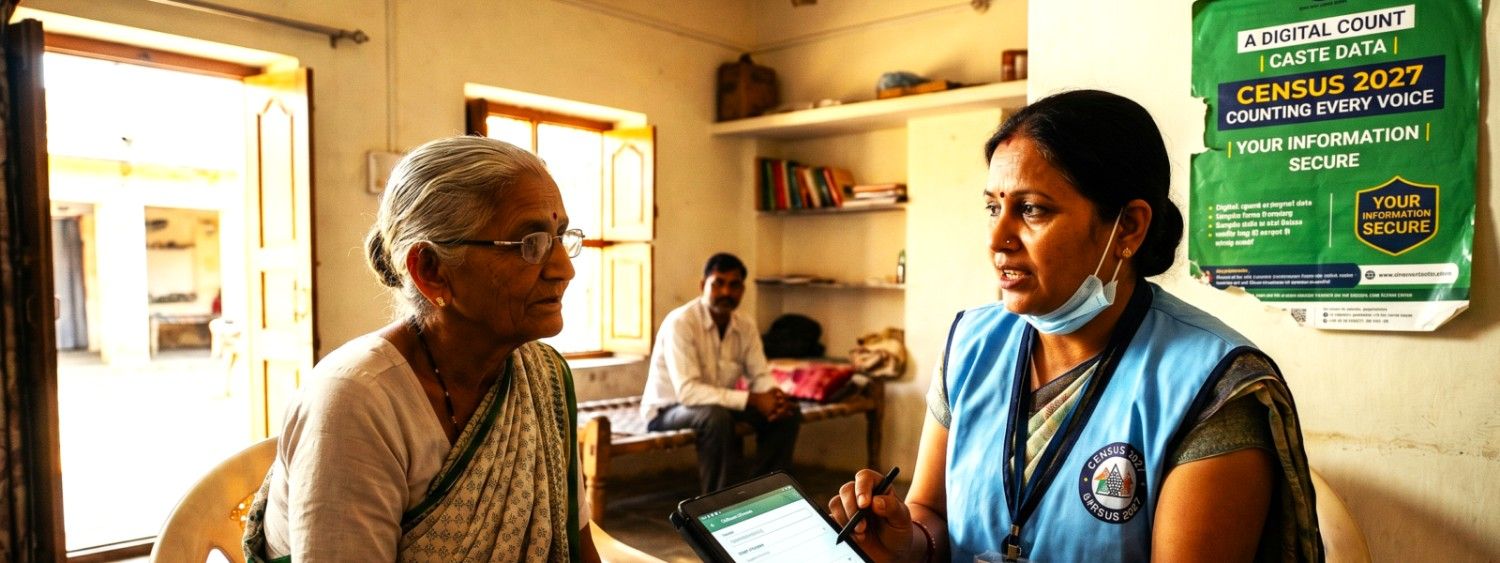
Introducing a historic milestone, India is counting its people. The pandamic caused the delay and the Union Government is executing Census 2027 the 16th national census since 1872 and the 8th since independence.
With a budget of ₹11,718.24 crore, this is the largest administrative and statistical exercise on earth. But it is far from standard. From a paperless workflow to a historic shift in how communities are mapped, Census 2027 is fundamentally updating how India understands itself.
The Timelines: A Two-Phase Rollout
A census as massive as India’s cannot happen overnight. The government is executing the survey in two carefully timed phases:
Phase 1: House Listing and Housing Census (April 2026 – September 2026): Field workers are visiting homes across states to gather information on housing quality, access to clean drinking water, electricity, sanitation, and household assets.
Phase 2: Population Enumeration (February 2027): This is the core counting phase. It records personal demographic profiles—including age, marital status, education, occupation, migration patterns, and fertility.
Going Green: India’s First Fully Digital Census
Say goodbye to the massive stacks of forms and clipboards. Census 2027 is breaking tradition by going 100% digital.
[Centralized CMMS Portal]
│
├──► HLO Mobile App (Used by Enumerators for Data Upload)
│
└──► Self-Enumeration Portal (Used by Citizens to Pre-fill Data)
1. The HLO Mobile App
Field enumerators are deploying a secure mobile application (available on both Android and iOS) to input survey responses in real-time. This app operates across 16 regional languages and feeds data straight to central databases, significantly speeding up data compilation and eliminating human transcription errors.
2. The CMMS Dashboard
The Census Management and Monitoring System gives administrators at the sub-district, district, and state levels a live bird’s-eye view of field progression, helping them spot and troubleshoot gaps immediately.
3. The Power of Self-Enumeration
In a first-of-its-kind feature, citizens do not have to wait around for an official to visit. You can proactively jump online to do your part.
- Log in to the secure web portal (
se.census.gov.in) with your mobile number. - Locate your household on the interactive digital map.
- Fill in your family details and complete the questionnaire.
- Save your unique Self-Enumeration ID (SE ID). When the enumerator arrives at your door, simply share this ID; they will verify it on their device, and your household is officially counted.
The Major Milestone: The 2027 Caste Census
The most debated element of Census 2027 is the integration of a nationwide caste census.
The Historical Context: India has not collected individual caste data for all communities during a national census since 1931. Following independence, national enumeration restricted its focus exclusively to Scheduled Castes (SC) and Scheduled Tribes (ST).
The Cabinet Committee on Political Affairs officially cleared comprehensive caste classification for Phase 2 (Population Enumeration) of this census.
Why is this data being gathered?
Welfare programs and reservation percentages rely heavily on demographic metrics. The Supreme Court recently upheld this policy direction, noting that accurate population breakdowns are essential for state governments to engineer targeted, fair socio-economic policies and affirmative action initiatives.
To bypass data collection confusion and misspellings, the digital census app uses a built-in drop-down caste directory to streamline registration.
Why is this data being gathered?
Welfare programs and reservation percentages rely heavily on demographic metrics. The Supreme Court recently upheld this policy direction, accurate population breakdowns are essential for state governments to engineer targeted, fair socio-economic policies and affirmative action initiatives.
To bypass data collection confusion and misspellings, the digital census app uses a built-in drop-down caste directory to streamline registration.

3 thoughts on “India’s Caste Census 2027: All You Need to Know”
love to read the article, keep posting Bosdika
keep commenting Aisle